Potassium Dichromate About
Potassium Dichromate
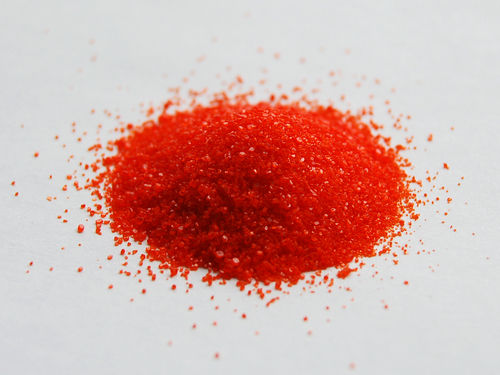
Potassium dichromate is accessible in red orange color and it easily dilutes in water. This crystalline organic salt is utilized as a strong oxidizing factor in different chemical procedures that include dye making, paint formulation, tanning agent production and varnishes formulation. Potassium dichromate is also used as one of the main raw materials for producing chromatic acid. This industrial grade chemical contains 0.09% calcium, 0.03% chloride, 0.02% sulphates and 0.03% moisture. Its standard has been checked as per its compositional accuracy, storage life and possible toxin content.
Specifications
- SULPHATES 0.02%
- CHLORIDES 0.03%
- CALCIUM 0.09%
- MOISTURE 0.03%
- MATTER INSOLUBLE IN WATER 0.01%
POTASSIUM DICHROMATE
SULPHATES | 0.02% |
CHLORIDES | 0.03% |
CALCIUM | 0.09% |
MOISTURE | 0.03% |
MATTER INSOLUBLE IN WATER | 0.01% |
Outstanding Analytical Reagent QualityPotassium dichromate is valued for its high purity (over 99%) and consistency, adhering to analytical reagent or industrial standards. It is indispensable in laboratories for volumetric analysis due to its precise oxidizing ability. Its accurate composition ensures reliable and reproducible outcomes for research and industrial quality control applications.
Versatile Industrial ApplicationsThis compound finds wide usage in chemical manufacturing, dyeing, photography, and as an oxidizing agent. Renowned for its efficacy in oxidizing organic compounds, potassium dichromate is used in synthesizing dyes and pigments, as well as in etching and metal finishing processes, underscoring its versatility across sectors.
Stringent Safety and Environmental MeasuresAs a potent toxic, carcinogenic, and environmental hazard, potassium dichromate requires robust safety practices. It is packaged with hazard labels in tightly sealed plastic or glass containers. Storage and handling should always include the use of PPE, and exposure should be avoided, reflecting the highest safety standards for hazardous substances.
FAQ's of Potassium Dichromate:
Q: How should potassium dichromate be stored safely?
A: Potassium dichromate must be stored in tightly closed plastic or glass containers, in a cool, dry, well-ventilated area, and away from combustible materials or reducing agents. Proper hazard labeling and regulatory compliance are essential to minimize any risks.
Q: What are the primary uses of potassium dichromate in industry?
A: This compound is widely used as an oxidizing agent in chemical synthesis, as an analytical reagent in laboratories, in dyeing textiles, and in photographic processing, owing to its strong oxidation properties and stability under normal conditions.
Q: When is personal protective equipment required during handling?
A: Personal protective equipment-including gloves, goggles, and protective clothing-should always be worn when handling potassium dichromate, regardless of amount or frequency, due to its high toxicity, carcinogenicity, and potential for severe health effects upon contact.
Q: Where can potassium dichromate exposure occur, and what are the first aid measures?
A: Exposure can occur via ingestion, inhalation, or skin contact, especially during handling or spills. In case of exposure, immediate medical attention is essential. Wash affected areas with plenty of water, move to fresh air if inhaled, and seek emergency help if ingested.
Q: What is the process for using potassium dichromate in analytical chemistry?
A: In analytical chemistry, potassium dichromate is primarily used in titrations as an oxidizing agent. Its stable structure and accurate purity make it ideal for measuring the concentration of reducing substances, ensuring precise and reproducible chemical analysis.
Q: How is potassium dichromate regulated in terms of safety and environment?
A: Potassium dichromate is classified as a hazardous material under environmental and workplace safety guidelines in India and internationally. Strict regulations govern its labeling, transport, storage, and disposal to mitigate risks to human health and the environment.
Q: What are the benefits of using potassium dichromate despite its toxicity?
A: Despite its hazardous nature, potassium dichromate's reliable oxidizing power, high purity, and stability render it irreplaceable in certain industrial and laboratory processes where accuracy, effectiveness, and consistent results are crucial.

 Send Email

 Send Inquiry




 Send Inquiry

 Send Inquiry
 Send SMS



